
August 20, 2026
How We Prepare Your Boat for Winter Storage
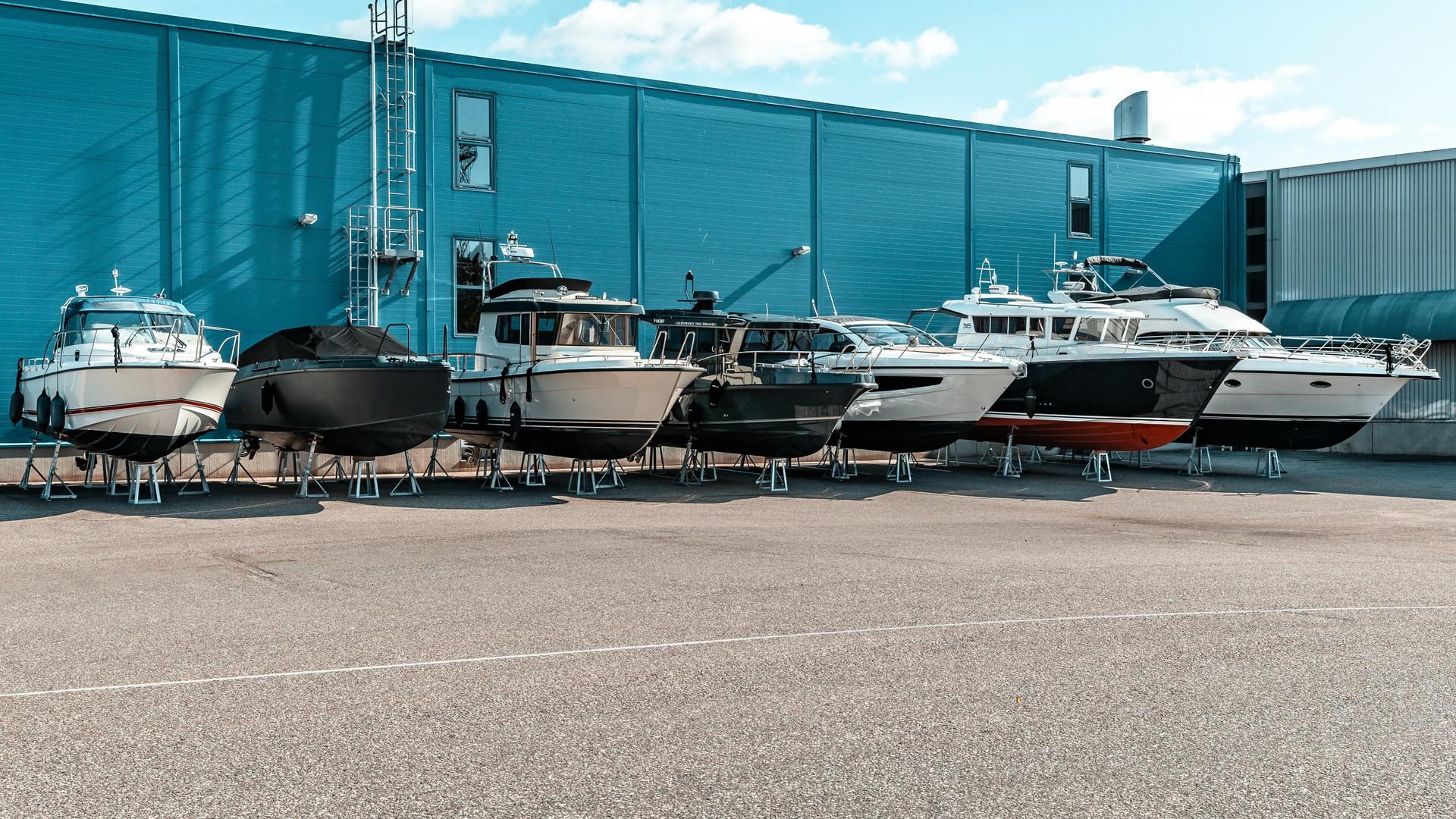
The season ends the same way every year: a cold morning, a last run in, and the boat comes out of the water. Lifting it and putting a cover on is the easy part. What happens between the pier and the storage hall is what decides how the boat comes back in the spring.
Here is how we prepare a boat for winter at our yard in Lappvik, and why each step is there.
1. A full wash — the whole boat, not just the bottom
The first thing that happens after the lift is a proper wash: hull, topsides, deck and fittings. Salt, grime and biological growth come off while they are still soft. Left to dry for a few weeks they take far more work to remove, and salt keeps pulling moisture out of the air all winter long.
There is a second reason, and it matters more than most owners realise: a clean boat is a boat you can actually inspect. Gelcoat damage, a blister, a through-hull starting to weep, a chafed seal — none of it is visible under a layer of salt and slime. And if anything is going to be repaired, painted or serviced over the winter, the work starts on a clean surface anyway.
2. Engine winterization
Antifreeze is run through the raw water circuit, and the engine is put away according to the manufacturer's schedule for the season.
Our storage halls are heated, so frost is not the threat here that it is in an open yard or under a tarpaulin. We do it anyway — because freezing is not the only reason to winterize. Raw water left standing in the block, the heat exchanger and the impeller housing keeps corroding for six months whether it freezes or not. Antifreeze with corrosion inhibitor displaces it and protects the passages while the engine sits still.
Our workshop is an authorised Volvo Penta service centre and a certified Mercury Marine partner, so the winterization is done to the schedule the engine manufacturer specifies — not a generic routine.
3. Batteries
There are two ways to do this properly, and both work. Either charge the batteries fully and disconnect them, or leave them on a good charger for the whole winter. What you should not do is leave them half charged and still connected to standby loads.
A lead-acid battery left partly discharged sulphates — the plates harden, capacity drops, and it does not come back. That is why so many boats will not crank in April on a battery that was fine in October. A battery is a cheap thing to look after and an annoying thing to replace on the first warm weekend of the year.
4. Well supported — stands and cradles
A boat that sits on land for six months is carrying its own weight in a way it never does in the water. We use CE-approved, high-quality stands, placed against the structural points of the hull so the load is properly spread and the boat stands securely.
Poor support is not a theoretical problem. Badly placed or undersized stands can leave a hull deformed by spring — stress marks in the gelcoat, doors and hatches that no longer close, bulkheads working loose. It is slow, quiet damage, and it is entirely avoidable. This is one of the places where the equipment a yard uses genuinely matters.
Then it goes inside
Our storage buildings are heated to a steady +8–10 °C through the winter. A stable temperature keeps humidity under control, which is what prevents mould in the interior, moisture in the electronics and repeated freeze–thaw cycles working on the structure. No meltwater, no wind, no tarpaulin chafing the finish for six months.
Getting the boat there is straightforward: leave it at our large pier in the harbour when your season is over, and we lift it with a hydraulic trailer and move it into storage. We handle boats up to 60 tons.
Storage places are booked through the autumn and the halls fill up. If you want a place this winter — and want the winterization handled at the same time — call us on +358 20 155 20 40, email info@nylundsboathouse.com, or request an offer on our winter storage page.
Read more: Painting and gelcoat · Refits · Contact us
News & Media
Related posts
Nylunds Boathouse continues operations in Lappvik
Our group has sold its ownership in Port of Lappvik Ab. Nylunds Boathouse continues in Lappvik as before — no change for customers or partners.
5 Common Boat Problems in Summer — and When to Call a Mechanic
Overheating, dead batteries, propeller damage, water in the bilge, water in the fuel — the most common mid-season boat problems explained by our Volvo Penta and Mercury authorized workshop.
Safe on the Water – What to Do If Your Boat Breaks Down
Practical advice for boaters in the Hanko archipelago. What to do in emergencies, who to call, and how to prepare for the unexpected on the water.